01
Ivotion Dent
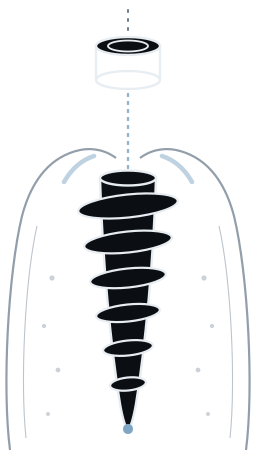
Monochromatic DCL tooth material with high translucency and lifelike fluorescence. 20 mm disc.
Ask any laboratory what your surgical guide is made from. Most will not tell you, and some do not know. Here is ours, in full, with the figures and the documents behind them.
Every guide we ship is printed in KeyPrint® KeyGuide® from Keystone Industries — a Class I biocompatible medical device resin formulated for one purpose: transparent surgical guides for guided implant placement. We do not substitute. We do not print guides in a generic model resin because a batch ran out.
A guide flexes under hand pressure and under the drill. 106 MPa of flexural strength with a 2,400 MPa modulus is what keeps the sleeve where it was planned while you are cutting. A template that deforms does not warn you — it simply gives you a different angle and a different depth than the one you approved, and you find out afterwards.
KeyGuide prints clear, so you keep direct visual control of seating. You can confirm the guide is fully seated before the first drill enters bone, rather than inferring it.
Provisionals are milled from Ivoclar Ivotion discs. In an Ivotion disc the highly cross-linked PMMA tooth material and the denture base material are co-polymerised in a single manufacturing process, with no additional adhesive component — a direct chemical bond, formed industrially under controlled conditions.
There is no adhesive layer, because there is no adhesive. The interface that usually fails first in a provisional does not exist in this one.
Monochromatic DCL tooth material with high translucency and lifelike fluorescence. 20 mm disc.
The disc is manufactured under factory-controlled conditions, not cured on a laboratory bench. Consistency between one case and the next is a property of the material, not of the day it was made.
The disc is cut on vhf S5 and K5 five-axis machines, built by vhf camfacture in Germany, holding 3 µm repetition accuracy. The fit of a provisional is decided at this step, not at the chairside.
Guides are supplied with the manufacturer-validated steam sterilisation protocol, and any part that fails inspection is remade rather than shipped. Pouches comply with EN ISO 11607 and ANSI/AAMI ST79, rated to at least 137 °C.
The full protocol, written to be printed and kept in the sterilisation room, is on the surgical guides page.
Seventy-four systems means one laboratory for every brand in your practice, rather than a separate captive service for each manufacturer you work with.
Guided surgery services compete on price. The savings have to come from somewhere, and they come from the parts you cannot see: a generic resin instead of a device-grade one, a printed provisional instead of a milled disc, an inspection step quietly dropped. None of it shows in a photograph. None of it shows on a website — which is precisely why almost nobody publishes what is on this page.
Ask any laboratory for the same list: the resin by name, the provisional material by name, the biocompatibility standards it passed, the sterilisation parameters it was validated to. It is a reasonable question and it takes a minute to answer. If it cannot be answered, you have learned something useful.
CBCT and intraoral scan. You get a plan, a price and a delivery date — and nothing is manufactured until you approve it.